Posts

Showing posts with the label hawker centres

Changi Village and Changi Point - with Nature Trails, Nasi Lemak, Beach and former British Barracks

Image
Changi was famous for its coconut plantations in the 1800s. By 1845, Changi Point was already a fashionable retreat for picnics and beach parties. At Changi Village, also known as 14 1/2 milestone Changi Road, prior to World War II, many facilities sprouted to serve the British officers and families of the Royal Air Force. Before British colonisation, the area around Sungei Changi or more commonly knows as Changi Creek, which is a short river that runs next to Changi Beach Park, was inhabited by indigenous Malay communities. These kampongs or villages relied on the creek for fishing, which was the primary source of livelihood back then. The livelihoods of kampong residents living in Changi were shaped by the area’s resources and geographical landscape. While some villages were sustained by coastal trades, other inland villages relied on agriculture. Now, Changi Village is still a rustic village at the eastern corner of Singapore where the tallest building is barely five storey high d...

Geylang Serai and Joo Chiat - Market, Traditional Food, Malay Emporium

Image
Once known as the Malay Emporium of Singapore and although it was developed later than the more glamorous and historical Kampong Glam , Geylang Serai has long been associated with the Malay ethnic community of Singapore with history of the area dated back to early 19th century. It is one of the oldest Malay settlements in Singapore. Located between Changi Road and Sims Avenue, the main attraction of the greater Geylang Serai is the busy Geylang Serai Market, affectionately known amongst the Malays as Pasar Lama (old market). Pasar Baru (new market) is the opposite building called Joo Chiat Complex, which was completed in 1985 on the site of the former Changi Market. Designed like a traditional Malay house, Geylang Serai Market comprises two storeys consisting of a wet market on the ground floor and a cooked food or hawker centre on the upper floor. It was first opened in 1964 by the first prime minister of Singapore Lee Kwan Yew. It was redeveloped in 2009 and reopened in 2010. It is ...

Teh Tarik (Pulled tea) - A comfort afternoon tea

Image
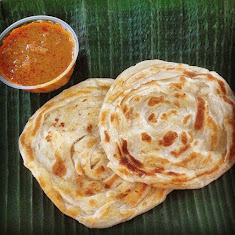
The calories rich but tasty teh tarik (or spelled as teh tarek) or pulled tea is a unique milk tea found in Malaysia and Singapore. It is made of black tea in combination with sweetened condensed milk (or evaporated milk for less sweetness, and tossing or dragging (tarik) the tea from one container to another at a height to create a frothy effect. This tea is usually drank while having roti prata . Well you can drink it with about any snacks or dishes or you can just sip it on its own as the teh tarik is like a dessert beverage by itself, full if sweetness from the condensed milk and sugar. There is also teh masala or the spice tea, but for locals here we tend to stick with the simpler teh tarik. Masala tea may appeal more to Indians. At many local coffee shops, teh-C is a lingo used to mean tea with evaporated milk to differentiate from the concentrated condensed milk. The letter C actually stand for ' cair ', a Malay word for diluted or unsweetened. That applies to kopi-C t...

Cheng teng - cooling, refreshing dessert drink
Image
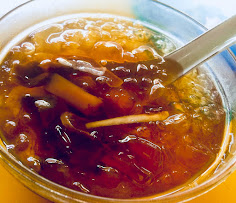
Cheng teng is a uniquely sweet local dessert or comfort drink that has been around for generations. This icy cold dessert drinks are popular especially given our local weather that are hot and humid. You can also have your cheng teng (also spelled as cheng tng ) warm or hot. Bedok Corner cheng-teng Cheng teng can be served either hot or cold. It is a potpourri of ingredients that include longan , ginko nuts , lily bulbs , white fungus , red dates , lianzi , barley, etc. Cold cheng teng is added with shaved ice. It is a sweet ‘cooling’ tasting dessert, like most desserts here. Cheng teng is believed to be able to get rid of heatiness in the hot and humid Singapore weather due to the tonic effect of some of the ingredients, which are herbal in nature. Some ingredients are used as part of traditional Chinese medicine, which have been used for centuries. But with so many ingredients in a bowl, cheng teng tastes very refreshing and sweet instead of herbal-ish. The hot or warm version is ev...

Bedok Food Centre (Bedok Corner) - Once Kampong Bedok

Image
Bedok Food Centre is a hawker centre affectionately known as Bedok Corner . Simply because it is located at the corner of Bedok Road and Upper East Coast Road. A compact place with 31 stalls where you can find and taste traditional local delicacies such as satay , ayam penyet , laksa , rojak , bubur kampong (kampong style porridge), sup kambing (mutton soup), mee soto , chicken rice, char kway teow, gado-gado, Hokkien mee, roti john and snacks such as banana or chempedak fritters, epok-epok or curry puffs. There is a popular local dessert cheng teng stall, a few seafood stalls that sell the perennial seafood dishes such as the spicy sambal stingray, cumi sotong (squid) and sambal lala. Bubur is congee or porridge and kampong means village. Chempedak is artocarpus integer , in the same family as jackfruit. Bedok Food Centre a.k.a. Bedok Corner The words food centre and hawker centres are used interchangeably, and they basically mean the same. In many countries the term hawker c...

Lontong - a hearty Malay dish

Image
Lontong is a popular traditional malay dish, which can be eaten anytime, during breakfast, lunch, even dinner. The dish comprised of compressed rice cakes with curry-ish gravy (sayur lemak or lodeh) whose ingredients include vegetables such cabbage (lots of it), long beans, fried tofu, carrots, and egg. The rice cakes or boiled compressed rice are similar to soto ayam or ketupat found in satay dish, except lontong is roundish due to the shape of the banana-leaf wrapped rice inside the metal mould, though these one can find the pre-cooked version in supermarkets and sundry stores. Sambal chilli or chilli paste is optional too for those who wants the added zest. But what is lontong without the sambal right? The sambal tend to be of the sweeter type, not the spicy sambal belacan type. Do you notice the serunding? Lontong would not be complete without the serunding! Serunding is the golden brown fried coconut flakes. You can get lontong like the one shown here for about $4.50. Egg is opt...

Mee soto and Soto ayam

Image
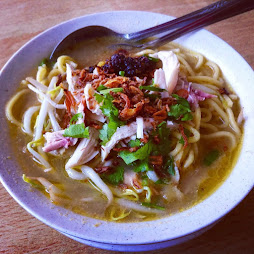
Mee soto is a spicy chicken noodle soup commonly found in Singapore, Malaysia and Indonesia. Mee means noodles. The spiciness depends on how much black-ish color chili you put in your noodles. This hot chili topping is optional, to add zest to the taste. If you have been to Indonesia, you probably would have come across soto. Soto originates from Indonesia, which is a soupy dish of broth, meat and vegetables. Simple yet delicious. Mee soto The main ingredients of mee soto are yellow Hokkien noodles, bean sprouts and slices of chicken ( ayam ) sprinkled with fried shallots and some mint leaves. The soup or gravy contains coriander and lemongrass that gives it a unique fragrant smell and taste. The noodles may also come in thinner rice vermicelli type. Mee soto can be found in many hawker centres or food courts and sells for between $3.50 to $4.50. This noodle is usually sold by Malay stall holders. Cheap, spicy, good and tasty! The yellow noodles are similar to the ones in mee rebus ,...

Popiah (Spring Roll) - delicious snacks or appetisers

Image
Popiah or spring roll. It can be the whitish wet version or the brownish deep-fried ones. These spring rolls are popular local delicacies. The ingredients can include but not limited to eggs, prawns, turnip, carrots, peanuts, lettuce, parsley, garlic, bean sprout, sweet sauce, chilli paste (the quantity of chilli paste depends on the spiciness that you want it to be) that are wrapped in popiah skin which is paper thin wheat flour to hold all or some of these ingredients! Many people think it is the skin that makes or break a popiah. And the filling of vegetables, seafood, eggs and chilli, which is optional, need to be well-drained before being tightly rolled or wrapped. The popiah still need to be moist but not soggy. Some vendors will add a dash of crushed peanut bits to make it crispy. Kway Guan Huat Popiah at Joo Chiat You can get popiah at most hawker or food centres . The popiah can be the deep-fried version or the wet types, depending on personal preference. You can get a wet ty...

Laksa - unique noodle dish with Persian twist

Image
Laksa is a popular spicy and tasty noodle dish that originated from the Peranakan, descendents from the early Chinese immigrant who married local Malay women thus gave rise to the fusion of flavours from the ingredients used. This dish is very popular with both Chinese and Malay alike, and of course to the many tourists or visitors to this island who have got hooked on it. Curry Laksa The laksa noodle is the thick rice noodle type. The laksa curry is a rich spicy coconut-based noodles soup, the ingredients which may include bean sprouts, tofu (taupok), cockles , slices of chicken and egg. It is usually topped with a spoonful of sambal belacan , a fermented shrimp and chilli paste, and laksa leaf for the added zest. The Malays call laksa leaf daun kesum rather than daun laksa. Daun means leaf. Cockles' laksa is the more common type of laksa but there are other options such as those containing pieces of chicken for those who are allergic to seafood. Laksa leaf is a herb which is a...

Porridge (congee) - Breakfast and comfort food

Image
The good old humble rice porridge or congee made its way into american fast food restaurants. There is chicken (what else!) porridge breakfast meal sold for $3.60 at KFC that includes a cup of coffee or tea. If you buy ala carte the porridge cost $2.60. A good hearty breakfast or meal to start your day. At some KFC outlets you can surf for free too while having your brekky. At Long John Silver you can also get porridge set complete with two half-boiled eggs for $5.20. Half-boiled eggs are usually part of kaya toast set , but still delicious to be mixed with congee as well. It is certainly a great way to start your day by having a hot comfort soft meal of porridge or congee with generous amount of nicely smelled fried shallots sprinkled on top of it. Black soya sauce and pepper are optional, but a bit of soya sauce is a must for many, to give some added taste and zest to otherwise bland-looking dish. Breakfast porridge at KFC You can get one for only $1.80 at Old Chang Kee, which is goo...